 正版
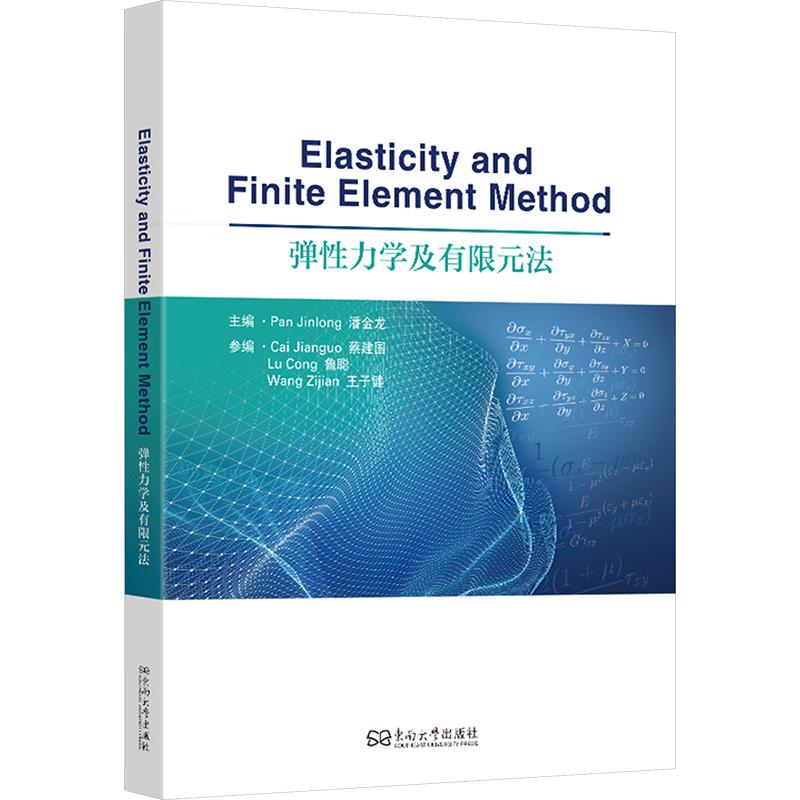
Elasticityandfiniteelementmethod 弹性力学及有限元法
- 书名
- Elasticityandfiniteelementmethod 弹性力学及有限元法
- 作者
- 潘金龙 主编
- 出版社
- 东南大学出版社
- 出版时间
- 2026-09-01
- ISBN
- 9787576629897
- 货号
- 1204566615
- 品相
- 全新
- 分类
- 当代·科技
- 书名
- Elasticityandfiniteelementmethod 弹性力学及有限元法
- 作者
- 潘金龙 主编
- 出版社
- 东南大学出版社
- 出版时间
- 2026-09-01
- ISBN
- 9787576629897
- 货号
- 1204566615
- 品相
- 全新
- 分类
- 当代·科技
目录▼
Chapter 1 Introduction
1.1 Introduction to Elasticity
1.1.1 Definition and Development History of Elasticity
1.1.2 Introduction to the Finite Element Method (FEM)
1.2 Relationship Between Elasticity and Other Branches of Solid Mechanics
1.3 Several Basic Concepts in Elasticity
1.4 Fundamental Assumptions in Elasticity
1.5 Chapter Summary
Exercises
References
Chapter 2 Basic Theory of Spatial Problems in Elasticity
2.1 Stress State of a Point in an Elastic Body
2.2 Principal Stresses and Principal Stress Directions
2.2.1 Principal Stresses, Maximum and Minimum Principal Stresses
2.2.2 Principal Stress Directions
2.2.3 Maximum and Minimum Shear Stresses
2.3 Basic Equations of Spatial Problems
2.3.1 Differential Equations of Equilibrium
2.3.2 Geometrical Equations
2.3.3 Physical Equations
2.4 Boundary Conditions
2.5 Basic Equations of Axisymmetric Problems
2.6 Chapter Summary
Exercises
References
Chapter 3 Theory of Plane Problems
3.1 Plane Stress and Plane Strain
3.2 Basic Equations in Plane Problems
3.3 Stress at a Point in Plane Problems
3.4 Boundary Conditions and Saint-Venants Principle
3.5 Solution of Plane Problems in Terms of Displacements
3.6 Solution of Plane Problems in Terms of Stresses
3.7 Case of Constant Body Force and Stress Function
3.8 Chapter Summary
Exercises
References
Chapter 4 Solution of Plane Problems in Cartesian Coordinates
4.1 Inverse Method
4.1.1 Polynomial Solution with Inverse Method
4.1.2 Stress Solution of a Rectangular Beam Subjected to Pure Bending
4.1.3 Displacement Solution of a Rectangular Beam Subjected to Pure Bending
4.2 Semi-inverse Method
4.2.1 Solution of a Simply Supported Beam subjected to a Uniformly Distributed Load
4.2.2 Solution of a Wedge Subjected to Gravity and Liquid Pressure
4.3 Chapter Summary
Exercises
References
Chapter 5 Solution of Plane Problems in Polar Coordinates
5.1 Differential Equations of Equilibrium in Polar Coordinates
5.2 Geometrical and Physical Equations in Polar Coordinates
5.3 Coordinate Transformation of Stress Components
5.4 Stress Function and Consistency Equation in Polar Coordinates
5.5 Stresses and Displacements of Axisymmetric Problems
5.6 A Circular Ring or Cylinder Subjected to Uniform Pressures
5.7 A Tunnel Subjected to Uniform Pressure
5.8 Stress Concentration of a Circular Hole
……
文摘▼
This book is written to accommodate the demand for international talent cultivation in civil engineering in recent years, combined with the teaching practice experience of the course group for many years.
This book is divided into two main parts: elasticity theory and finite element method, with a total of 10 chapters, covering the basic concepts and assumptions of elasticity theory, the basic theory and solutions of spatial and plane problems, thin plate bending problems, variational methods and energy principles, the basic principles and solution methods of finite element method, the introduction and application of ABAQUS software, etc.
As an introductory textbook for elasticity and finite element method, this book focuses on the exposition of basic concepts and theories, while highlighting the ideas, methods, and steps for solving elastic mechanical problems. It combines theoretical derivation with engineering cases to enhance problem-solving skills through exercises and case studies. Combining online MOOCs can enhance teaching interaction, and utilizing modern information technology can extend and expand textbook knowledge, making textbook content more vivid and visualized.
This book can serve as a textbook for courses on elasticity and finite element method for engineering undergraduates in higher education institutions or universities, and can also be used as a reference book for engineering and technical personnel.