 正版
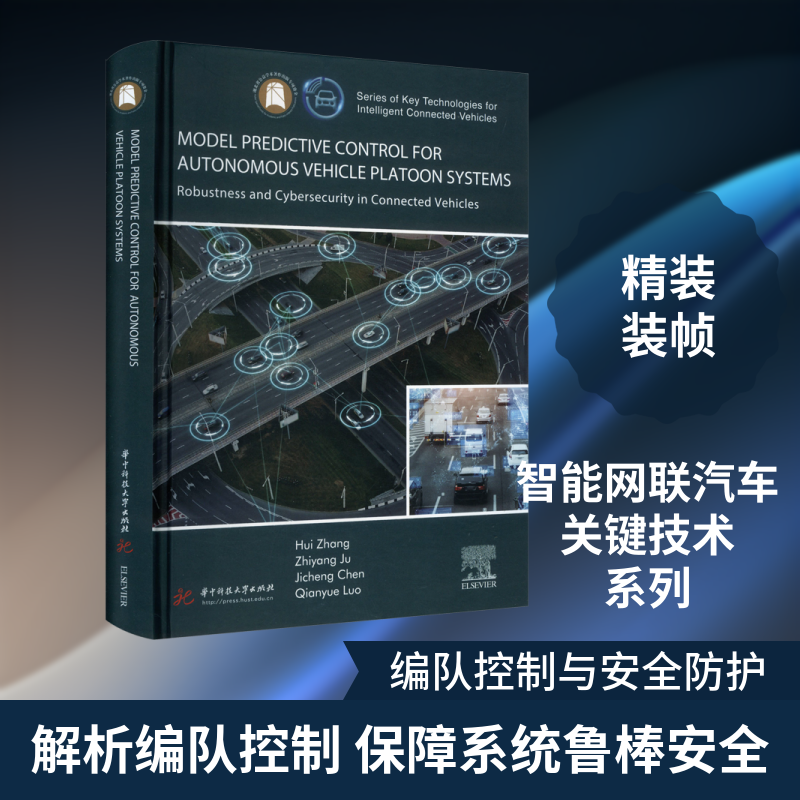
车辆编队系统模型预测控制:鲁棒性与信息安全(英文版)
- 书名
- 车辆编队系统模型预测控制:鲁棒性与信息安全(英文版)
- 作者
- 张辉 等 著
- 出版社
- 华中科技大学出版社
- 出版时间
- 2026-03-01
- ISBN
- 9787577217741
- 货号
- 1204380824
- 品相
- 全新
- 分类
- 当代·工业
- 书名
- 车辆编队系统模型预测控制:鲁棒性与信息安全(英文版)
- 作者
- 张辉 等 著
- 出版社
- 华中科技大学出版社
- 出版时间
- 2026-03-01
- ISBN
- 9787577217741
- 货号
- 1204380824
- 品相
- 全新
- 分类
- 当代·工业
编辑推荐▼
1.全面介绍最先进的联网和自动化车辆排系统的发展2.介绍了用于约束处理和鲁棒性改进的先进鲁棒和随机模型预测控制算法设计方法3.从稳健基于管的分布式MPC和随机基于管的分布MPC的角度介绍了严格的理论稳定性分析4.提供各种基于滤波器的车间攻击检测方法和基于事件的弹性车队控制设计方法
作者简介▼
Hui Zhang is a Professor at the Beihang University, China, and has published more than 150 peer-reviewed journal papers.
Zhiyang Ju is an Assistant Professor at the Beijing Institute of Technology, China. He has published 20 SCI-indexed papers in vehicle platooning control and vehicle attack detection.
Jicheng Chen is a Postdoctoral Research Fellow at the Hong Kong University of Science and Technology, China. He has published over 20 SCI-indexed papers in the fields of control theory, vehicle dynamics control, cybersecurity, and autonomous vehicles.
Qianyue Luo is a PhD student at the University of Hong Kong, China, and his research interests include heterogeneous vehicles dynamics modelling and connected vehicle control.
目录▼
PART 1 Vehicular platoon system design: fundamentals and robustness
1 Introduction 3
1.1 Introduction 3
1.1.1 Background of attacks on CAVs 3
1.1.2 Security of CAVs 5
1.1.3 Scope of this survey 6
1.2 Preliminaries to attack detection and resilience for CAVs 8
1.2.1 Vehicle dynamics 8
1.2.2 Introduction to attacks in CAVs 13
1.2.3 Overview of the survey 15
1.3 Intra-vehicle network attack detection and resilience 17
1.3.1 Intra-vehicle network attack detection 17
1.3.2 Resilience strategies against intra-vehicle network attacks 22
1.4 Sensor attack detection and resilience 24
1.4.1 Sensor attack detection 24
1.4.2 Resilience strategies against sensor attacks 29
1.5 Inter-vehicle network attack detection and resilience 34
1.5.1 Inter-vehicle network attack detection 34
1.5.2 Resilience strategies against inter-vehicle network attacks 37
1.5.3 Security of CAVs containing malicious vehicles 41
1.6 Summary and future perspectives 43
Acknowledgments 46
References 46
2 Robust tube-based DMPC platoon control design 59
2.1 Introduction 59
2.2 Modeling and preliminaries 61
2.2.1 Vehicle longitudinal dynamics 61
2.2.2 Communication structure of vehicle platoons 63
2.2.3 Platooning control objectives 63
2.3 Control problem formulation 64
2.3.1 Feedback control and disturbance-compensation control 65
2.3.2 Distributed MPC feedforward control 68
2.4 Integrated control design procedure 76
2.4.1 Offline computation 76
2.4.2 Online control implementation 79
2.5 Simulation and comparison results 79
2.5.1 Scenario 1: Performance under disturbance effects 80
2.5.2 Scenario 2: Performance under acceleration/deceleration 87
2.6 Conclusions 88
Acknowledgments 95
References 95
3 Stochastic DMPC platoon control design 99
3.1 Introduction 99
3.2 Problem formulation 102
3.2.1 Platoon model 102
3.2.2 DSMPC problem for pltoons 106
3.3 Tractable DMPC formulation 108
3.3.1 Probailistic constraints reformulation 108
3.3.2 Constraint tightening 111
3.3.3 Terminal constraints design 113
3.3.4 Approximated DMPC 115
3.4 Recursive feasibility of the candidate solution 116
3.5 Asymptotic performance of the stochastic DMPC scheme 119
3.6 Simulations 124
3.6.1 Simulation 1 124
3.6.2 Simulation 2 127
3.7 Conclusions 132
Acknowledgments 132
References 133
4 Asynchronous self-triggered stochastic DMPC platoon control design 137
4.1 Introduction 137
4.2 Problem setup 141
4.2.1 Platoon modeling 141
4.2.2 Information flow and asynchronous self-triggered mechanism 143
4.2.3 Objective 145
4.3 Cost function and probabilistic constraints handling 145
4.3.1 Asynchronous communication among vehicular platoon 146
4.3.2 Cost function 147
4.3.3 Probabilistic constraints handling 149
4.4 Stochastic self-triggered DMPC scheme 153
4.4.1 Stochastic self-triggered DMPC algorithm 153
4.4.2 Analysis of theoretical properties 154
4.5 Numerical examples 157
4.5.1 Parameter selections and evaluation metrics 158
4.5.2 Comparison with periodic time-triggered stochastic DMPC algorithm 159
4.5.3 Evaluation of computational complexity, emergency braking safety and tuning parameters 162
4.6 Conclusions 165
Acknowledgments 166
References 166
PART 2 Advanced vehicular platoon system design: sampling security, resilience and event-triggered
5 Attack detection using a UFIR estimator 171
5.1 Introduction 171
5.1.1 Background of attack detection in vehicle platoon systems 172
5.1.2 Introduction of UFIR estimator and related attack estimation 172
5.1.3 Main results 173
5.2 Problem formulation 174
5.2.1 Dynamic model of the local vehicle 174
5.2.2 Problem formulation 177
5.3 Failure of attack estimation using canonical FIR unknown input estimation 179
5.3.1 Algorithm of a UFIR estimator without attack 179
5.3.2 Failure of existing FIR-based unknown input estimation in attack detection 181
5.4 Modified UFIR estimator for attack detection and estimation 182
5.4.1 Modified UFIR estimator 183
5.4.2 Properties of estimated intermediate results 184
5.5 Attack detection and estimation 192
5.5.1 Analysis of expectation of [m -1] 192
5.5.2 Detection and estimation of the attack signal 193
5.6 Simulation results 196
5.6.1 Results of the modified UFIR estimator 197
5.6.2 Results of the attack estimation 199
5.7 Conclusion 201
Acknowledgments 201
References 202
6 Distributed deception attack detection 205
6.1 Introduction 205
6.2 Problem formulation 208
6.2.1 Communication protocol 209
6.2.2 Dynamic model of an individual vehicle 210
6.2.3 Distributed Kalman filters 213
6.2.4 Deception attack detection and estimation problem 215
6.3. Attack detection and estimation 216
6.3.1 Attack detection and estimation using modiied GLR approach 217
6.3.2 Attack identification based on modified GLR approach 219
6.4 Simulation results and comparison 221
6.4.1 x2 detector for attack detection 221
6.4.2 Simulation results 223
6.5 Conclusions 230
Acknowledgments 230
References 230
7 Attack detection using moving horizon estimation 235
7.1 Introduction 235
7.2 Problem formulation 237
7.2.1 Platoon modeling 237
7.2.2 Cyberattack modeling 237
7.3 Main results 239
7.3.1 General framework 239
7.3.2 Attack estimation using moving horizon estimation 240
7.3.3 Attack-resilience distributed model predictive control 241
7.4 Simulation examples 242
7.4.1 Scenarios description 242
7.4.2 Simulation results 243
7.5 Conclusions 245
Acknowledgments 247
References 247
8 Event-triggered resilient platoon control 249
8.1 Introduction 249
8.2 Problem formulation 254
8.2.1 Longitudinal vehicle platoon model 254
8.2.2 Information flow and packet transmission in VANET 256
8.2.3 DoS attacks and detection 257
8.2.4 DoS-attack-aware dynamic event-triggering condition 258
8.2.5 Motivation example and control objectives 261
8.3 Distributed event-triggered secure MPC against DoS attacks 262
8.3.1 Event-triggered finite-horizon optimal control problem 262
8.3.2 Vehicular beacon data packet structure 264
8.3.3 Dynamic event-triggered distributed secure MPC algorithm 265
8.4 Closed-loop properties of the DMPC algorithm 267
8.4.1 Inter-sampling-time interval 267
8.4.2 Feasibility analysis 267
8.4.3 Stability analysis 270
8.5 Numerical example 273
8.5.1 Parameter selections and performance evaluation metric 274
8.5.2 Evaluation of platooning under DoS-attack-aware dynamic event-triggered condition 275
8.5.3 Evaluation of pltooning under various DoS attack durations 276
8.6 Conclusion and future work 281
Acknowledgments 283
References 283
Index 287
文摘▼
Model Predictive Control for Autonomous Vehicle Platoon Systems: Robustness and Cybersecurity in Connected Vehicles provides a comprehensive introduction to connected and automated vehicular platoon system design. Connected vehicles form platoons by utilizing vehicle-to-vehicle communication to reduce the distances between cars and trucks within the platoon, thereby improving traffic efficiency and reducing aerodynamic drag. This capability makes it possible for many cars or trucks to accelerate or brake simultaneously, while also making closer headways between vehicles possible by eliminating the reacting distances needed for human reactions. The book considers the key issues of robustness and cybersecurity. In the controller design part of the book, several practical problems, such as constraint handling, optimal control performance, robustness against disturbance, and resilience against cyberattacks, are reviewed. In addition, the book provides detailed theoretical analysis of the stability of the platoon under multiple control schemes.