 正版
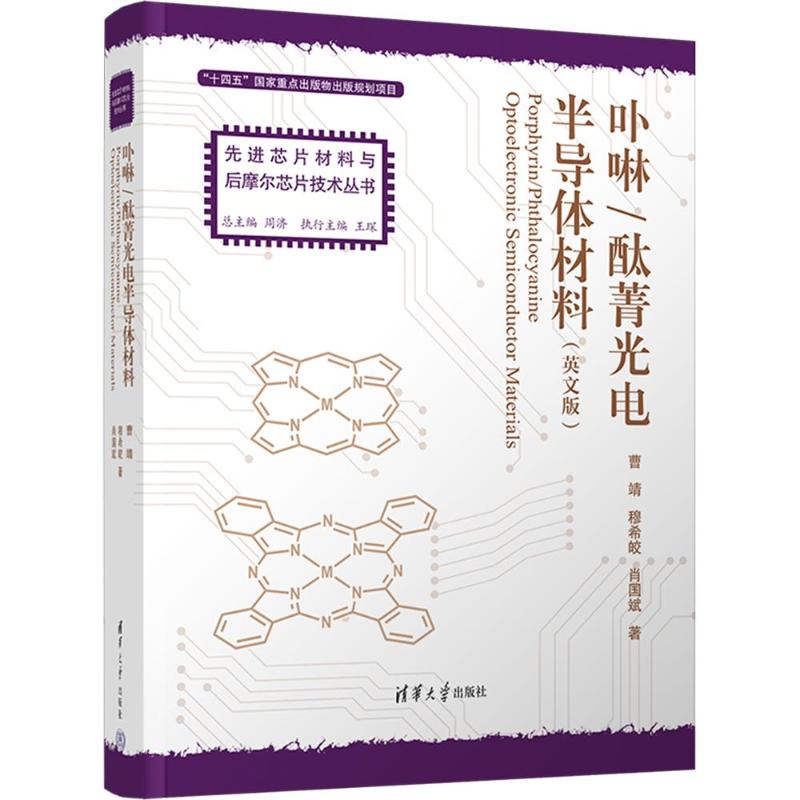
PORPHYRIN/PHTHALOCYANINE OPTOELECTRONIC SEMICONDUCTOR MATERIALS(卟啉/酞菁光电半导体材料)
- 书名
- PORPHYRIN/PHTHALOCYANINE OPTOELECTRONIC SEMICONDUCTOR MATERIALS(卟啉/酞菁光电半导体材料)
- 作者
- 曹靖,穆希皎,肖国斌 著
- 出版社
- 清华大学出版社
- 出版时间
- 2025-09-01
- ISBN
- 9787302703273
- 货号
- 1203981131
- 品相
- 全新
- 分类
- 当代·工业
- 书名
- PORPHYRIN/PHTHALOCYANINE OPTOELECTRONIC SEMICONDUCTOR MATERIALS(卟啉/酞菁光电半导体材料)
- 作者
- 曹靖,穆希皎,肖国斌 著
- 出版社
- 清华大学出版社
- 出版时间
- 2025-09-01
- ISBN
- 9787302703273
- 货号
- 1203981131
- 品相
- 全新
- 分类
- 当代·工业
作者简介▼
曹靖,兰州大学教授,博士生导师,厦门大学获得博士学位,导师:郑南峰院士,随后到兰州大学化学化工学院工作,中国化学会“青年人才托举工程”托举人才、强国青年科学家提名等,担任Chin. Chem. Lett.期刊编委以及Inorg. Chem. Front.、Chin. J. Struct. Chem.期刊青年编委。研究方向为:能源材料设计及光伏应用,近年来在J. Am. Chem. Soc.、Angew. Chem. Int. Ed.、Adv. Mater.等化学/材料领域顶级期刊发表论文60余篇。
目录▼
Chapter 1Research Background and Prospects of Porphyrin/Phthalocyanine Optoelectronic Semiconductors
1.1Introduction to Porphyrin and Phthalocyanine Materials
1.2Unique Optoelectronic Properties of Porphyrin and
Phthalocyanine Materials
1.3Development History of Porphyrin/Phthalocyanine
1.4Market Demand and Technical Bottlenecks in Optoelectronic
Semiconductors
1.5The Technological Background of the Post-Moore Era
1.6Future Potential of Porphyrin/Phthalocyanine Materials in
Optoelectronic Applications
1.7References
Chapter 2Structure and Properties of Porphyrin/Phthalocyanine Molecules
2.1Introduction
2.2Modification of Porphyrin Materials
2.2.1β-Position Modification of Porphyrins
2.2.2Meso-Position Modification of Porphyrins
2.2.3Peripheral Modification of Phthalocyanines
2.2.4Non-Peripheral Modification of Phthalocyanines
2.3Central Metal Modification on Porphyrin/Phthalocyanine Materials
2.3.1Metal-Centered Tuning of Porphyrin and Phthalocyanine Properties
2.3.2Tuning Porphyrin and Phthalocyanine Properties via Metal Oxidation States
2.4Aggregation of Porphyrin and Phthalocyanine Materials
2.4.1Light Absorption and Electronic Structure
2.4.2Charge Transport Properties
2.4.3Catalytic Activity
2.4.4Fluorescence and Photoluminescence
2.4.5Conclusion: Tuning Aggregation for Optimized Performance
2.5Properties Regulation Through Extended Conjugation in Phthalocyanines
2.6Properties Regulation Through Fused-Ring Systems
2.7Properties Regulation Through Symmetry
2.7.1Chiral Control and Optimization of Phthalocyanine
2.7.2Macroscopic Crystal Structures of Porphyrin/Phthalocyanine
2.8References
Chapter 3Synthesis Methods of Porphyrin/Phthalocyanine Materials
3.1Introduction
3.2The Synthesis Method of Porphyrin Molecules
3.2.1Classical Method
3.2.2Modular Method
3.2.3Other Synthesis Methods
3.2.4Porphyrin Substituent Modification
3.2.5Metal Insertion
3.3The Synthesis Method of Phthalocyanine Molecules
3.3.1Synthesis of Symmetric Phthalocyanines
3.3.2Metal-Free and Metal Phthalocyanine
3.3.3Synthesis of Asymmetrical Phthalocyanines
3.3.4Solid-Phase and Liquid-Phase Synthesis of Phthalocyanines
3.3.5Synthesis of Substituted Phthalocyanine Complexes
3.3.6Synthesis of Polymeric Metal Phthalocyanines
3.4Synthesis of Sandwich-Type Metal Phthalocyanine and
Porphyrin Complexes
3.4.1Preparation of Symmetrical Sandwich-Type Metal
Phthalocyanine Complexes
3.4.2Synthesis of Asymmetric Sandwich-Type Metal
Phthalocyanine Complexes
3.4.3Synthesis of Symmetric Sandwich-Type Metal
Porphyrin Complexes
3.4.4Synthesis of Asymmetric Sandwich-Type Metal
Porphyrin Complexes
3.4.5Synthesis of Sandwich-Type Mixed Porphyrin and
Phthalocyanine Metal Complexes
3.5Synthesis of Metalloporphyrin-Phthalocyanine Hybrids
3.6References
Chapter 4Theoretical Methods and Simulations of Porphyrin/
Phthalocyanine Based Photoelectric Materials
4.1Introduction
4.2Density Functional Theory
4.2.1Theoretical Background of Density Functional
Theory
4.2.2Applications of DFT in PorphyrinPhthalocyanine
Photoelectric Materials
4.2.3Combination and Synergistic Effects of DFT and
Experiment
4.3Time-Dependent Density Functional Theory
4.3.1Theoretical Background of TD-DFT
4.3.2Application and Analysis of TD-DFT in Porphyrin-
Phthalocyanine Photoelectric Materials
4.4Molecular Dynamics Simulation Methods
4.4.1Principles of Classical Molecular Dynamics
4.4.2Principles of Ab-Initio Molecular Dynamics
4.4.3Application and Analysis of MD in Porphyrin-
Phthalocyanine Materials
4.5Artificial Intelligence Predictions Fundamental Theory
4.5.1Machine Learning Algorithms
4.6Applications of Intelligent Simulations in Material Design
4.6.1Overview of Intelligent Simulation Technology
4.6.2Multi-Method Analysis of Intelligent Simulation
Technology in Material Design
4.6.3Intelligent Simulation and Experimental Co-Design
4.7Typical Case Studies and Latest Advances in Computational
Research on Porphyrin-Phthalocyanine Materials
4.8References
Chapter 5Optical Properties of Porphyrin/Phthalocyanine Materials
5.1Introduction
5.2Electronic Structure of Porphyrin and Phthalocyanine
Molecules
5.2.1π-Conjugated System and Electronic Properties
5.2.2Regulation of Electronic Structure by Metal
Coordination
5.2.3Substituent Effects and Self-assembly Behavior
5.2.4Charge Transfer and Photoinduced Behavior
5.2.5The Combination of Theory and Experiment:
Understanding Electronic Structure
5.2.6Comparison of Porphyrin and Phthalocyanine
5.3Absorption Spectrum of Porphyrin Phthalocyanine
Molecules
5.3.1Absorption Spectrum Characteristics and Molecular
Arrangement
5.3.2Interface Effects in Absorption Spectra
5.3.3Absorption Spectrum in Langmuir-Blodgett films
5.4Fluorescence Properties
5.4.1Metal Centers on Fluorescence Properties
5.4.2Fluorescence Characteristics Regulation by
Substituents
5.4.3Self-Assembly Effects on Fluorescence Properties
5.4.4Fluorescence Performance Regulation Though
Structure
5.4.5Free Radical Fluorescence Quenching
5.5Photodynamic of Porphyrin/Phthalocyanine
5.5.1The Basic Mechanism of Photodynamic Therapy
5.5.2The Relationship Between the Structure of
Photosensitizers and Their Photodynamic
Properties
5.5.3Applications of Porphyrin and Phthalocyanine in
Photodynamic
5.5.4Outlook of Photodynamic Properties
5.6Nonlinear Optical Properties of Porphyrin Phthalocyanine
5.6.1Multiphoton Absorption Properties
5.6.2Optical Limiting Effect
5.6.3ThirdOrder Nonlinear Optical Effects
5.6.4Optical Nonlinear Applications of Porphyrin/
Phthalocyanine
5.7Conclusion
5.8References
Chapter 6Applications of Porphyrin/Phthalocyanine Photosensitizers
Materials
6.1Introduction
6.2Structural Characteristics of Porphyrin/Phthalocyanine
Photosensitizers
6.3Physical and Chemical Properties of Porphyrin/Phthalocyanine
Photosensitizers
6.4Photophysical Characteristics of Porphyrin/Phthalocyanine
Photosensitizers
6.5Applications in Semiconductor Devices
6.5.1Solar Cell
6.5.2Organic Field-Effect Transistors
6.5.3Photodetectors and Other Optoelectronic Devices
6.6Applications in Biosensors
6.6.1DNA Detection
6.6.2Protein and Enzyme Detection
6.6.3Cellular Imaging and Disease Diagnosis
6.6.4Biosensor Applications Combined with
Nanomaterials
6.7Applications in Chemical Sensors
6.7.1Metal Ion Detection
6.7.2Organic Compound and VOC Detection
6.7.3Composite Sensors and Nanomaterial Integration
6.7.4Real-time Monitoring and Environmental
Applications
6.8Applications in Gas Sensors
6.8.1NH3 Sensing
6.8.2Nitrogen Oxide Sensing
6.8.3Oxygen Sensing
6.9Summary and Prospect
6.10References
Chapter 7Electrical Properties of Porphyrin/Phthalocyanine Optoelectronic
Materials
7.1Introduction
7.2Experimental and Theoretical Analysis of Charge Mobility
7.2.1Electrical Conductivity of Porphyrin and Phthalocyanine
Materials
7.2.2Intramolecular Conductivity Mechanism
7.2.3The relation of Polarons and Bi-polarons to electrical
conductivity
7.2.4Doping Effect
7.2.5Coordination Effect of the Metal Center
7.2.6Influence of Molecular Structure and Environmental
Factors
7.2.7Summary
7.3Evaluation Parameters of Conductivity in Porphyrin/
Phthalocyanine Materials
7.3.1Conductivity
7.3.2Mobility
7.3.3Hall Effect Parameters
7.3.4Electrochemical Impedance
7.3.5Band Structure and Work Function
7.3.6Summary
7.4Semiconductor Conductivity Properties of Porphyrin/Phth
alocyanine Materials
7.4.1Overview of Semiconductor Conductivity Principles
7.4.2Conductivity Mechanism of Organic
Semiconductors
7.4.3Conductivity Mechanism of Porphyrin and
Phthalocyanine-Based Organic Semiconductor
Materials
7.4.4Applications of Porphyrins and Phthalocyanines in
Organic Electronic Devices
7.4.5Summary
7.5Ionic Conductivity of Porphyrin/Phthalocyanine Materials
7.5.1Basic Principles of Ionic Conductivity
7.5.2Ionic Conductivity in Organic Materials
7.5.3Ionic Conductivity of Porphyrin and Phthalocyanine
Materials
7.5.4Relationship Between Ionic Conductivity and Material
Structure
7.5.5Applications of Ionic Conductivity in Porphyrin/
Phthalocyanine Materials
7.5.6Summary
7.6Conductivity Regulation in Porphyrin/Phthalocyanine
Materials
7.6.1Molecular Structure Regulation
7.6.2Molecular Stacking and Arrangement
7.6.3Doping Techniques
7.6.4Environmental Regulation
7.6.5Composite Materials
7.7References
Chapter 8Application of Porphyrins in Charge Transport Materials
8.1Introduction
8.2Charge Transport Materials in Optoelectronic
Semiconductors
8.2.1Basic Concepts of Charge Transport
8.2.2Photoelectric Semiconductors Require Efficient Charge
Transport
8.2.3The Impact of Charge Transport Materials on
Optoelectronic Semiconductors
8.3Basic Charge Transport Properties
8.3.1Structural Characteristics and Functionalization
8.3.2Charge Transport Traits for Porphyrin/
Phthalocyanine
8.4Charge Transport Materials in Photoelectric Application
8.4.1Application in Organic Solar Cells
8.4.2Application in Perovskite Solar Cells
8.4.3Application in OLEDs
8.4.4Application in OFETs
8.5Applications of Porphyrin/Phthalocyanine Materials in
Sensing and Detection
8.5.1Development and Applications of Gas Sensors
8.5.2Electrochemical and Optical Sensing Innovations
8.5.3Applications in Environmental and Biological
Sensing
8.6Stability and Processability of Porphyrin/Phthalocyanine
Materials
8.6.1Stability of Porphyrin/Phthalocyanine Materials
8.6.2Processability of Porphyrin/Phthalocyanine
Materials
8.6.3Integrated Outlook and Future Directions
8.7Future Development and Prospects of Porphyrin/Phthalocyanine
Materials
8.7.1Introduction to Current Trends and Challenges
8.7.2Advancements in Material Synthesis and
Functionalization
8.7.3Improving Stability and Durability
8.7.4Enhancing Performance for Electronic and Photonic
Applications
8.8References
Chapter 9Integration of Porphyrin/phthalocyanine Optoelectronic Devices
9.1Introduction
9.1.1Basic principles of optoelectronic devices
9.1.2Classification of Optoelectronic Devices
9.1.3Application of Optoelectronic Devices
9.1.4Development of Optoelectronic Devices
9.2Structural Design of Porphyrin/Phthalocyanine Materials
in Photoelectrical Appliances
9.2.1Principles
9.2.2Dye-sensitized Solar Cells
9.2.3Organic Solar Cells
9.2.4Perovskite Solar Cells
9.2.5Organic Light-Emitting Diodes
9.3Process Optimization for Porphyrin/Phthalocyanine
Devices
9.3.1Dye-Sensitized Solar Cells
9.3.2Process Optimization in Organic Solar Cells
9.3.3Process Optimization in Perovskite Solar Cells
9.3.4Process Optimization in Organic Light-Emitting Diode
Devices
9.4Porphyrin/Phthalocyanines in Flexible Optoelectronic
Devices
9.4.1Advantages of Porphyrin/Phthalocyanines
9.4.2Porphyrin/Phthalocyanine In Flexible Optoelectronic
Devices
9.4.3Manufacturing of Porphyrin/Phthalocyanine Flexible
Optoelectronic Devices
9.4.4Application of Porphyrin/Phthalocyanine Flexible
Optoelectronic Devices
9.5Integrated Application of Porphyrin/Phthalocyanine Materials
in Optoelectronic Sensors
9.5.1Type of Porphyrin/Phthalocyanine Photoelectric Sensors
Application
9.5.2Manufacturing and Integration of Porphyrin/
Phthalocyanine Photosensor
9.5.3Application of Porphyrin/Phthalocyanine
Photosensors
9.6References
Chapter 10Photoelectric Application Prospects of Porphyrin/Phthalocyanine
Materials
10.1Introduction
10.2Optoelectronic Applications of Porphyrin/Phthalocyanine
Materials
10.2.1Thin-film Photovoltaic Cells
10.2.2Organic Light Emitting Diodes
10.2.3Photodetectors and Sensors
10.3The Future Development Direction of Porphyrin/
Phthalocyanine Materials
10.3.1Structural Optimization and Molecular Design
10.3.2Improvement of Environment Stability and
Processability
10.3.3Synergistic Effect with other Optoelectronic
Materials
10.3.4Potential Commercialization and Industrial
Applications
10.4Summary and Outlook
10.5References
Chapter 11Testing Techniques for Porphyrin/Phthalocyanine Optoelectronic
Devices
11.1Introduction
11.2Xray Diffraction
11.2.1Principle of XRD
11.2.2XRD Instrumentation
11.2.3Categories of XRD
11.2.4Application of XRD in Porphyrins/Phthalocyanin
Materials
11.3Scanning Electron Microscopy and Transmission Electron
Microscopy
11.3.1SEM and TEM Principle
11.3.2SEM and TEM Instrumentation
11.3.3Categories of SEM and TEM Imaging
11.3.4Application of SEM and TEM
11.4Atomic Force Microscopy
11.4.1AFM Principles of AFM
11.4.2AFM Testing Principle
11.4.3AFM Analysis Workflow
11.4.4Application of AFM in Porphyrin/Pathalocyanine
Materials
11.5External Quantum Efficiency
11.5.1Principle of EQE
11.5.2Application of EQE
11.6Transient Absorption Spectroscopy
11.6.1Principle of TAS
11.6.2Application of TAS in Porphyrin/Pathalocyanine
Materials
11.7Photoelectric Conversion Efficiency
11.7.1Principle of PCE
11.7.2Application of PCE in Porphyrin/Pathalocyanine
Materials
11.8Device Stability
11.8.1Significance of Stability in Materials
11.8.2Categories of Stability Assesment
11.8.3Methods for Stability Assessment
11.8.4Application of Stability Assessment
11.9References
Chapter 12Summary and Outlook
文摘▼
本书系统介绍了卟啉和酞菁两大类大环化合物的结构特点、电子与光物理特性及其在光电功能材料中的应用潜力。书中重点讨论了其独特的π共轭结构、可调控的金属中心和取代基修饰方式,并深入分析了它们在有机太阳能电池、有机发光二极管、场效应晶体管、光探测器以及传感与催化等领域的前沿进展。书稿兼顾基础与应用,既概述了分子设计与合成方法,也呈现了在能源、环境和柔性电子器件中的最新研究成果。本书适合化学、有机电子学、材料科学及能源科学等领域的研究人员和研究生参考使用,也可作为相关专业的教学与科研资料,为从事功能有机材料和器件开发的学者与工程师提供重要参考。