 正版
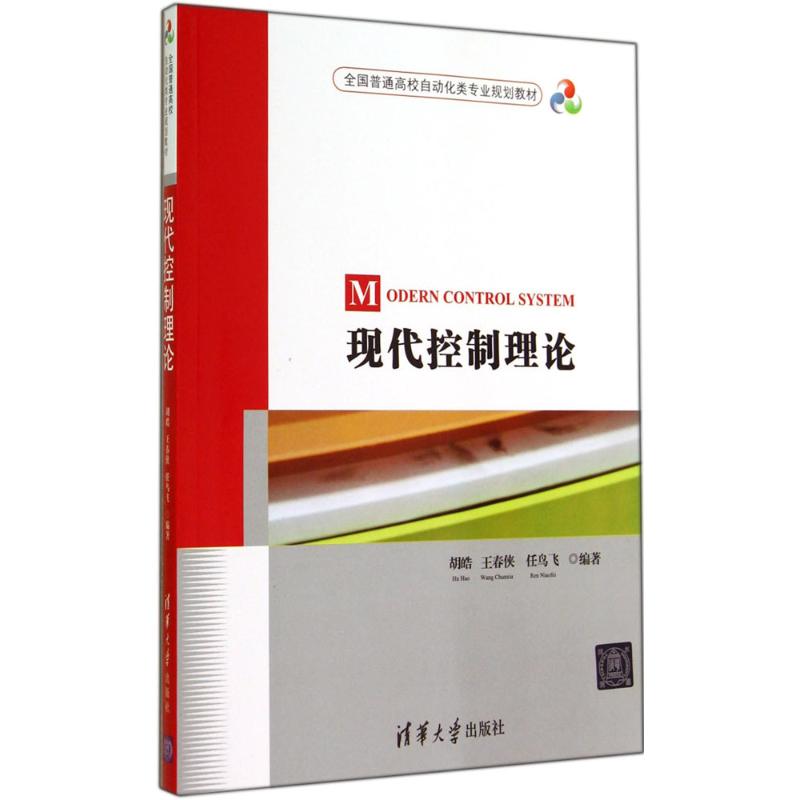
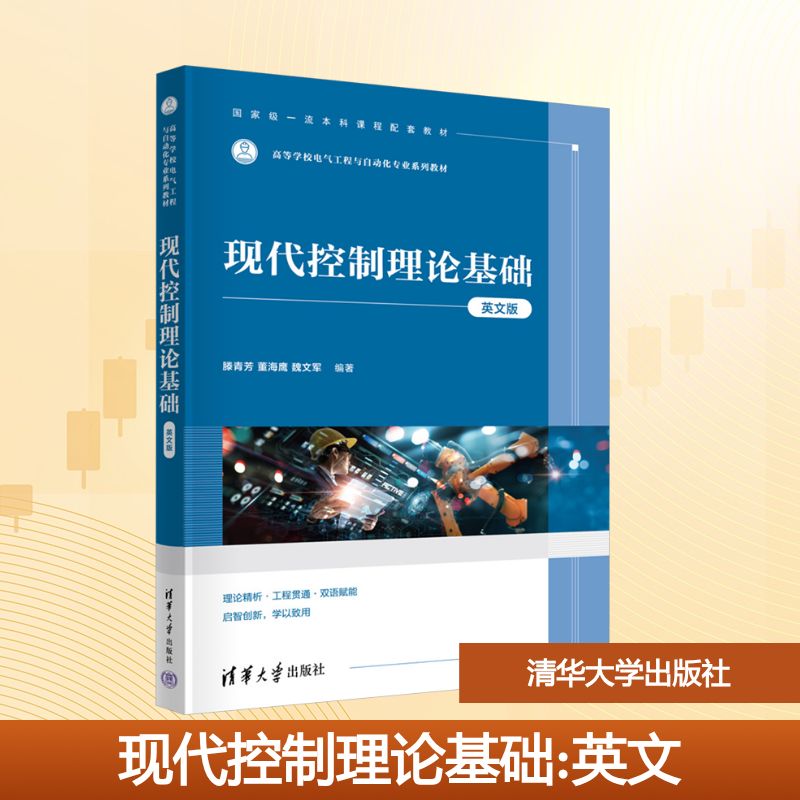
现代控制理论基础(英文版)
- 书名
- 现代控制理论基础(英文版)
- 作者
- 滕青芳,董海鹰,魏文军 编
- 出版社
- 清华大学出版社
- 出版时间
- 2025-05-01
- ISBN
- 9787302687986
- 货号
- 1203675924
- 品相
- 全新
- 分类
- 涉及近代·科技
- 书名
- 现代控制理论基础(英文版)
- 作者
- 滕青芳,董海鹰,魏文军 编
- 出版社
- 清华大学出版社
- 出版时间
- 2025-05-01
- ISBN
- 9787302687986
- 货号
- 1203675924
- 品相
- 全新
- 分类
- 涉及近代·科技
目录▼
Chapter 1 Introduction to Control Systems
1.1 Historical Review of Automatic Control Theory
1.2 Modern Control Theory versus Conventional Control Theory
1.2.1 Modern control theory
1.2.2 Modern control theory versus conventional control theory
1.2.3 Definitions
1.3 Design of Control Systems
1.4 Future Evolution of Control Systems
1.5 Outline of this Book
Chapter 2 Modeling In State Space
2.1 State Variable and State Space Expression
2.1.1 Some basic concept and definitions
2.1.2 State space expression
2.1.3 Relationship between transfer functions (or transfer matrix) and state-space equations
2.2 State Space Representation of Linear Dynamic System
2.2.1 State space representation of differential equation
2.2.2 From transfer function to state space representation
2.3 From Block Diagram to State Space Representation
2.4 Linear Transform of State Space Expression
2.4.1 Nonsingular linear transform (or similarity transformation)
2.4.2 Eigenvalues and eigenvectors of an n×n matrix A
2.4.3 State-space representation in canonical forms
2.5 State Space Representations of Discrete Systems
2.5.1 State-space representation of nth-order systems of linear difference equations in which the forcing function does not
involve difference terms
2.5.2 State space representation of nth-order systems of linear difference equations in which the forcing function involves
difference terms
2.6 Transformation of System Models with MATLAB
2.6.1 Transformation from transfer function to state space formulation
2.6.2 Transformation from state space to transfer function
Exercises
Chapter 3 Dynamic Analysis of Control System in State Space
3.1 Solving the Time-invariant Homogeneous State Equation
3.1.1 General solution of the scalar differential equation
3.1.2 General solution of the vector-matrix differential equation
3.1.3 State-transition matrix
3.2 Properties of State-transition Matrice
3.3 Calculation of Matrix Exponential Function
3.3.1 Direct calculation approach
3.3.2 Laplace transform approach
3.3.3 Linear transform approach
3.3.4 Cayley-Hamilton Theorem
3.4 Solution of Nonhomogeneous State Equations
3.4.1 Direct method (or integral method)
3.4.2 Laplace Transform Approach
3.5 Solution of Discrete Nonhomogeneous State Equations
3.5.1 Discretization of linear time-invariant dynamic equation
3.5.2 Approximation
3.5.3 Recursive algorithms of the discrete state equation
3.5.4 Z transform approach to the solution of the discrete state equation
3.6 Computation of Control System Response with MATLAB
3.6.1 Response to initial condition
3.6.2 Obtaining the response to an initial condition by use of the command initial
Exercises
Chapter 4 Controllability and Observability
4.1 Controllability of Linear Time-invariant Continuous System
4.1.1 Definition of controllability
4.1.2 Complete controllability criteria of continuous-time systems
4.1.3 Complete output controllability of continuous-time systems
4.2 Observability of Linear Time-invariant Continuous System
4.2.1 Definition of observability
4.2.2 Complete observability criteria of continuous-time systems
4.3 Controllable Canonical Form and Observable Canonical Form
4.3.1 Controllable canonical form of the single input system
4.3.2 Observable canonical form of the single output system
4.4 Principle of Duality
4.4.1 Dual system
4.4.2 Principle of duality
4.5 Controllability and Observability of Discrete Time-Invariant System
4.5.1 Controllability of discrete system
4.5.2 Observability of discrete system
4.5.3 Controllability and Observability of Discretized Systems
4.6 Structure Decomposition of Linear Time-invariant Continuous System
4.6.1 Structure decomposition according to controllability
4.6.2 Structure decomposition according to observability
4.6.3 Structure decomposition according to both controllability and observability
4.7 Computation of Controllability and Observability Matrix with MATLAB
Exercises
Chapter 5 Lyapunov Stability Analysis
5.1 Stability of Lyapunov Significance
5.1.1 Equilibrium state
5.1.2 Stability in the sense of Lyapunov
5.1.3 Asymptotic stability in a whole
5.1.4 Unstability
5.2 Definiteness of Scalar Function and Sylvester Theorem
5.2.1 Positive definite and semidefinite functions
5.2.2 Negative definite and semidefinite functions
5.2.3 Indefinite functions
5.2.4 Quadratic function
5.2.5 Sylvester theorem
5.3 Main Theorems of Lyapunovs Second Method
5.3.1 Lyapunov stability for time-varying system
5.3.2 Lyapunov stability for time-invariant system
5.3.3 Lyapunov stability for time-varying or time-invariant system
5.3.4 Instability for time-varying or time-invariant system
5.4 Stability Criteria for Linear Time-Invariant Systems
5.4.1 Basic theorem
5.4.2 Lyapunov function of linear time-invariant continuous systems
5.4.3 Lyapunov function of linear time-invariant discrete systems
Exercises
Chapter 6 Design of Control Systems in State Space
6.1 State Feedback and Output Feedback
6.1.1 State feedback
6.1.2 Output feedback
6.1.3 Controllability and observability of state feedback system
6.2 Pole Placement
6.2.1 Design by state feedback
6.2.2 Necessary and sufficient condition for arbitrary pole placement
6.2.3 Determination of state feedback matrix K
6.2.4 Choosing the locations of desired closed-loop poles
6.2.5 Comments on selecting state feedback gain matrix K
6.3 Stabilization Problem of Systems
6.4 Solving Pole Placement Problems with MATLAB
6.5 State Observers
6.5.1 Full-order state observer
6.5.2 Necessary and sufficient condition for full-order state observer
6.5.3 Determination of full-order state observer gain matrix Kc
6.5.4 Comments on selecting state observer gain matrix Kc
6.5.5 Integrated full-state feedback and observer
6.5.6 Separation property
6.5.7 Reference inputs for integrated full-state feedback and observer
6.5.8 Reduced-dimension state observer
6.6 Design of State Observers with MATLAB
6.7 Optimal Control Design
6.7.1 Optimal control design using error-squared performance indices
6.7.2 Optimal control design using riccati equation
6.8 Solving Quadratic Optimal Control Problems with MATLAB
6.9 Internal Model Design
6.9.1 Internal model design for tracking of a step input
6.9.2 Internal model design for tracking of a ramp input
Exercises
References
文摘▼
本书以状态空间法为核心,阐述了现代控制理论的基本原理及其分析和综合方法。全书共有6章,包含线性系统的状态空间描述、线性系统的运动分析、线性系统的能控性和能观性、李雅普诺夫稳定性分析、线性系统的状态综合。本书是作者根据我国现代控制理论课程教学要求、大量参考国际优秀原版教材,并总结近年来该课程双语教学实践经验的基础上编写的。
本书可作为高等院校自动化、电气工程及其自动化等控制类专业的现代控制理论双语教学教材,也可作为相关工程技术人员的参考书。