 正版
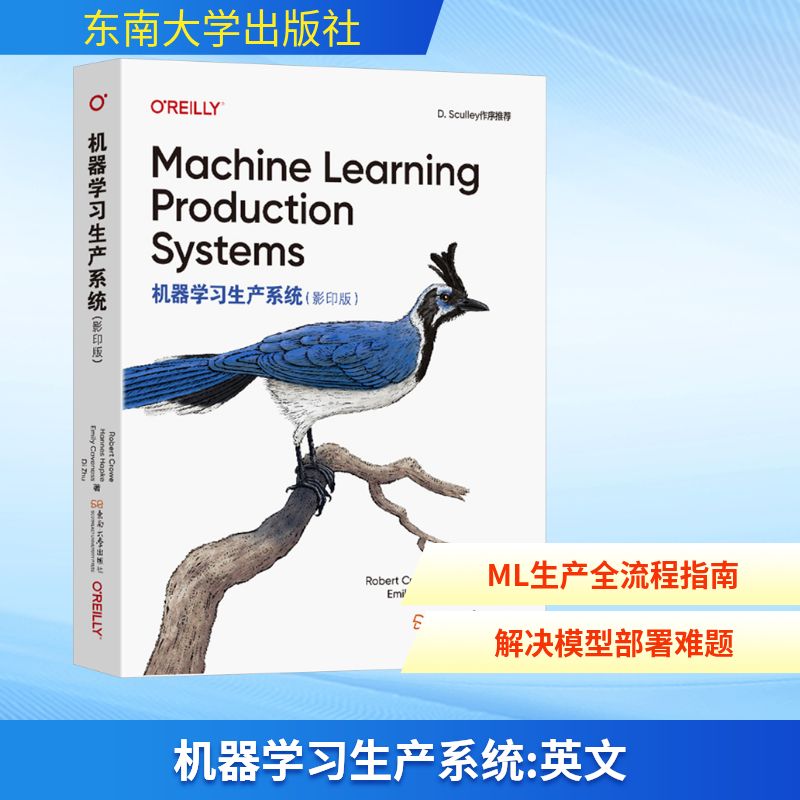
机器学习生产系统(影印版)
- 书名
- 机器学习生产系统(影印版)
- 作者
- (美)罗伯特·克洛(Robert Crowe) 等 著
- 出版社
- 东南大学出版社
- 出版时间
- 2025-04-01
- ISBN
- 9787576620054
- 货号
- 1203582389
- 品相
- 全新
- 分类
- 当代·工业
- 书名
- 机器学习生产系统(影印版)
- 作者
- (美)罗伯特·克洛(Robert Crowe) 等 著
- 出版社
- 东南大学出版社
- 出版时间
- 2025-04-01
- ISBN
- 9787576620054
- 货号
- 1203582389
- 品相
- 全新
- 分类
- 当代·工业
目录▼
Foreword
Preface
1.Introduction to Machine Learning Production Systems
What Is Production Machine Learning?
Benefits of Machine Learning Pipelines
Focus on Developing New Models,Not on Maintaining Existing Models
Prevention of Bugs
Creation of Records for Debugging and Reproducing Results
Standardization
The Business Case for ML Pipelines
When to Use Machine Learning Pipelines
Steps in a Machine Learning Pipeline
Data Ingestion and Data Versioning
Data Validation
Feature Engineering
Model Training and Model Tuning
Model Analysis
Model Deployment
Looking Ahead
2.Collecting,Labeling,and Validating Data
Important Considerations in Data Collection
Responsible Data Collection
Labeling Data:Data Changes and Drift in Production ML
Labeling Data:Direct Labeling and Human Labeling
Validating Data:Detecting Data Issues
Validating Data:TensorFlow Data Validation
Skew Detection with TFDV
Types of Skew
Example:Spotting Imbalanced Datasets with TensorFlow Data Validation
Conclusion
3.Feature Engineering and Feature Selection
Introduction to Feature Engineering
Preprocessing Operations
Feature Engineering Techniques
Normalizing and Standardizing
Bucketing
Feature Crosses
Dimensionality and Embeddings
Visualization
Feature Transformation at Scale
Choose a Framework That Scales Well
Avoid Training–Serving Skew
Consider Instance Level Versus Full Pass Transformations
Using TensorFlow Transform
Analyzers
Code Example
Feature Selection
Feature Spaces
Feature Selection Overview
Filter Methods
Wrapper Methods
Embedded Methods
Feature and Example Selection for LLMs and GenAI
Example:Using TF Transform to Tokenize Text
Benefits of Using TF Transform
Alternatives to TF Transform
Conclusion
4.Data Journey and Data Storage
Data Journey
ML Metadata
Using a Schema
Schema Development
Schema Environments
Changes Across Datasets
Enterprise Data Storage
Feature Stores
Data Warehouses
Data Lakes
Conclusion
5.Advanced Labeling,Augmentation,and Data Preprocessing
Advanced Labeling
Semi Supervised Labeling
Active Learning
Weak Supervision
Advanced Labeling Review
Data Augmentation
Example:CIFAR 10
Other Augmentation Techniques
Data Augmentation Review
Preprocessing Time Series Data:An Example
Windowing
Sampling
Conclusion
6.Model Resource Management Techniques
Dimensionality Reduction:Dimensionality Effect on Performance
Example:Word Embedding Using Keras
Curse of Dimensionality
Adding Dimensions Increases Feature Space Volume
Dimensionality Reduction
Quantization and Pruning
Mobile,IoT,Edge,and Similar Use Cases
Quantization
Optimizing Your TensorFlow Model with TF Lite
Optimization Options
Pruning
Knowledge Distillation
Teacher and Student Networks
Knowledge Distillation Techniques
TMKD:Distilling Knowledge for a Q&A Task
Increasing Robustness by Distilling EfficientNets
Conclusion
……
7.High-Performance Modeling.
8.Model Analysis.
9.Interpretability
10.Neural Architecture Search
11.Introduction to Model Serving
12.Model Servincl Patterns
13.Model Serving Infrastructure
14.Model Serving Examples
15.Model Manaqement and Delivery
16.Model Monitoring and Logging
17.Privacy and Legal Requirements
18.Orchestrating Machine Learning Pipelines
19.AdvancedTFX
20.ML Pipelines for Computer Vision Problems.
21.ML Pipelines for Natural Language Processing
22.Generative AI
23.The Future of Machine Learning Production Systems and Next Steps
Index
文摘▼
机器学习(ML)和人工智能(AI)领域正在蓬勃发展,几乎每天都有新的研究、模型和技术出现。面对如此丰富的选择,数据科学家、机器学习工程师和软件开发人员很容易迷失在将AI/ML模型从实验阶段推向生产的众多步骤中。
这本实用书籍专注于生产环境机器学习,指导你将ML模型转化为可行的产品和应用。生产环境机器学习涵盖了ML的所有领域,不仅限于简单的模型训练。本书特别强调了ML流水线,帮助你为ML生产系统奠定基础。
你即将开启探索之旅,学习将ML应用投入生产所需的广泛技术,以及需要考虑的问题和方法。关键的ML工程主题包括:
·数据收集、验证、存储、特征工程
·模型分析、服务、监控、日志记录
·使用TensorFlow Extended(TFX)和其他工具编排机器学习流水线
本书提供了深入的实例,包括适用于自然语言处理(NLP)和计算机视觉模型的端到端机器学习流水线。