 正版
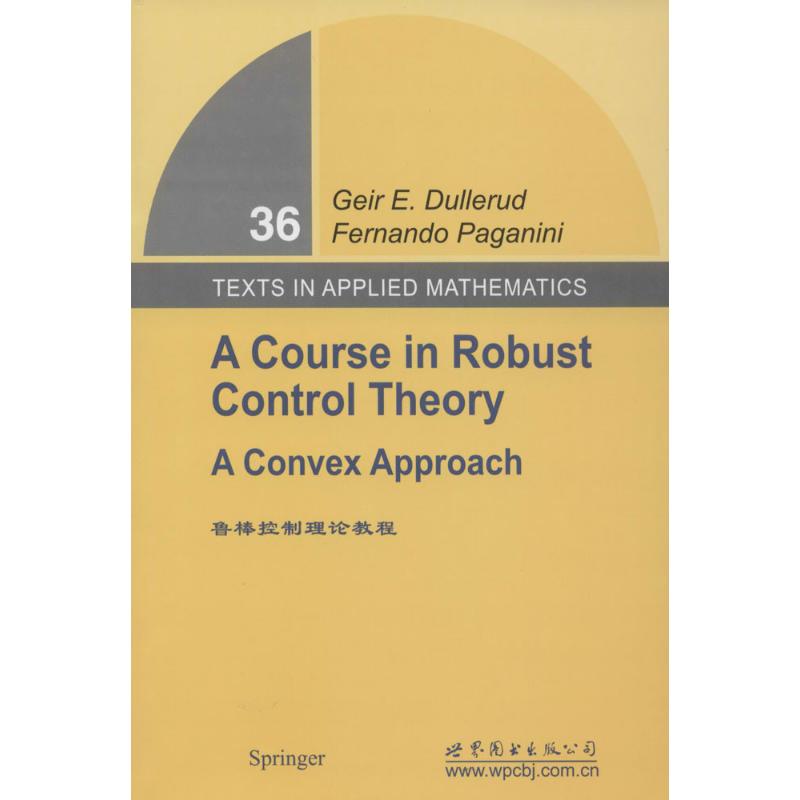
鲁棒控制理论教程
- 书名
- 鲁棒控制理论教程
- 作者
- 无 著
- 出版社
- 世界图书出版公司
- 出版时间
- 2014-07-01
- ISBN
- 9787510077791
- 货号
- 1201002609
- 品相
- 全新
- 分类
- 当代·大学教材
- 书名
- 鲁棒控制理论教程
- 作者
- 无 著
- 出版社
- 世界图书出版公司
- 出版时间
- 2014-07-01
- ISBN
- 9787510077791
- 货号
- 1201002609
- 品相
- 全新
- 分类
- 当代·大学教材
目录▼
Series Preface
Preface
Figures
0 Introduction
0.1 System representations
0.1.1 Block diagrams
0.1.2 Nonlinear equations and linear decompositions
0.2 R,obust control problems and uncertainty
0.2.1 Stabilization
0.2.2 Disturbances and commands
0.2.3 Unmodeled dynamics
Notes and references
1 Preliminaries in Finite Dimensional Space
1.1 Linear spaces and mappings
1.1.1 Vector spaces
1.1.2 Subspaces
1.1.3 Bases, spans, and linear independence
1.1.4 Mappings and matrix representations
1.1.5 Change of basis and invariance
1.2 Subsets and convexity
1.2.1 Some basic topology
1.2.2 Convexsets
1.3 Matrixtheory
1.3.1 Eigenvalues and Jordan form
1.3.2 Self—adjoint, unitary, and positive definite matrices
1.3.3 Singular value decomposition
1.4 Linear matrix inequalities
Exercises
Notes and references
2 State Space System Theory
2.1 The autonomous system
2.2 Controllability
2.2.1 Reachability
2.2.2 Properties of controllability
2.2.3 Stabilizability
2.2.4 Controllability from a single input
2,3 Eigenvalue assignment
2.3.1 Single—input case
2.3.2 Multi—input case
2.4 Observability
2.4.1 The unobservable subspace
2.4.2 Observers
2.4.3 Observer—based Controllers
2.5 Minimal realizations
2.6 Transfer functions and state space
2.6.1 Rational matrices and state space realizations
2.6.2 Minimality
Exercises
Notes and references
3 Linear Analysis
3.1 Normed and inner product spaces
3.1.1 Complete spaces
3.2 Operators
3.2.1 Banach algebras
3.2.2 Some elements ofspectral theory
3.2.3 Adjoint operators in Hilbert space
3.3 Frequency domain spaces: Signals
3.3.1 The space L2 and the Fourier transform
3.3.2 The spaces H2 and H21 and the Laplace transform
3.3.3 Summarizing the big picture
3.4 Frequency domain spaces: Operators
3.4.1 Time invariance and multiplication operators
3.4.2 Causality with time invariance
3.4.3 Causality and H∞
Exercises
Notes and references
4 ModelRealizations and Reduction
4.1 Lyapunov equations and inequalities
4.2 Observability operator and gramian
4.3 Controllability operator and gramian
4.4 Balanced realizations
4.5 Hankeloperators
4.6 Model reduction
4.6.1 Limitations
4.6.2 Balanced truncation
4.6.3 Inner transfer functions
4.6.4 Bound for the balanced truncation error
4.7 Generalized gramians and truncations
Exercises
Notes and references
5 Stabilizing Controllers
5.1 System stability
5.2 Stabilization
5.2.1 Static state feedback stabilization via LMIs
5.2.2 An LMI characterization of the stabilization problem
5.3 Parametrization ofstabilizing controllers
5.3.1 Coprime factorization
5.3.2 Controller parametrization
5.3.3 Closed—Ioop maps for the general system
Exercises
Notes and references
6 H2 Optimal Control
6.1 Motivation for H2 control
6.2 Riccati equation and Hamiltonian matrix
6.3 Synthesis
6.4 State feedback H2 synthesis via LMls
Exercises
Notes and references
7 H∞ Synthesis
7.1 Two important matrix inequalities
7.1.1 The Kalman—Yakubovich—Popov Lemma
7.2 Synthesis
7.3 Controller reconstruction
Exercises
Notes and references
8 Uncertain Systems
8.1 Uncertainty modeling and well—connectedness
8.2 Arbitrary block—structured uncertainty
8.2.1 A scaled small gain test and its sufficiency
8.2.2 Necessity of the scaled small gain test
8.3 The structured singular value
8.4 Time invariant uncertainty
8.4.1 Analysis of time invariant uncertainty
8.4.2 The matrix structured singular value and its upper bound
Exercises
Notes and references
9 Feedback Control of Uncertain Systems
9.1 Extended spaces and stability
9.1.1 A general result on stability
9.1.2 Causality and maps on L2—extended
9.2 Robust stability and performance
9.2.1 R,obust stability under arbitrary structured uncertainty
9.2.2 R,obust stability under LTI uncertainty
9.2.3 Robust performance analysis
9.3 Robust controller synthesis
9.3.1 R,obust synthesis against
9.3.2 R,obust synthesis against
9.3.3 D—K iteration: A synthesis heuristic
Exercises
Notes and references
……
10 Further Topics: Analysis
11 Further Topics: Synthesis
A Some Basic Measure Theory
B Proofs of Strict Separation
C μ—Simple Structures
Notation
References
Index
文摘▼
本书旨在为研究生水平的学生提供一部学习鲁棒控制理论的教程。重点强调最新进展,同时将这个领域的核心原理和几乎全部的基本工具都加以说明,教学目的是介绍一种学习鲁棒理论的综合、系统的框架,为学生提供学习和理解研究领域的控制理论背景。本书对数学专业和计算机专业的科研人员、想进入科研领域的研究生、和对高等控制技巧感兴趣的工程人员是必不可少的。