 正版
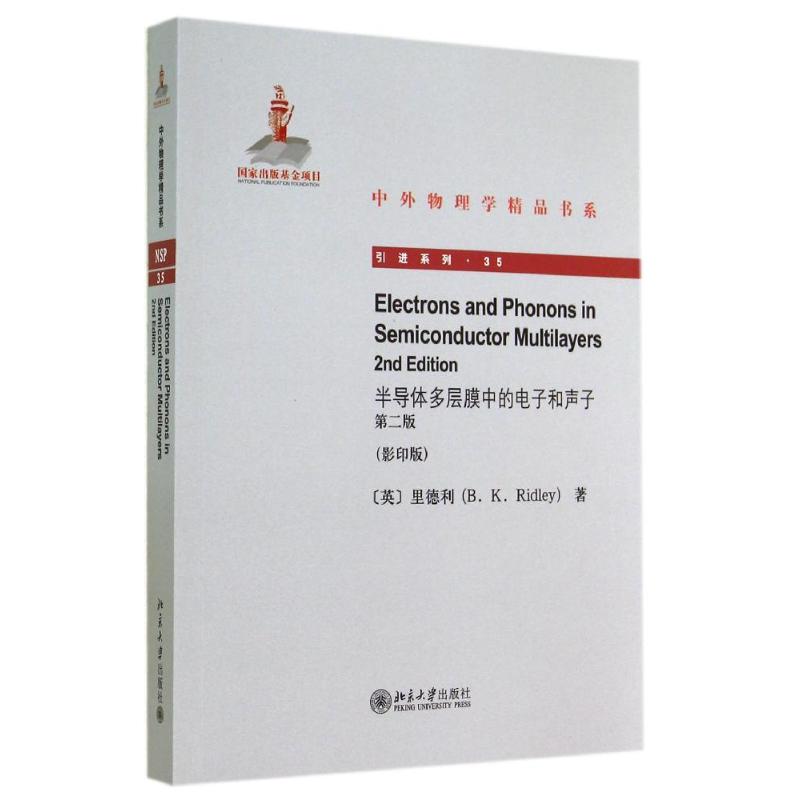
半导体多层膜中的电子和声子
- 书名
- 半导体多层膜中的电子和声子
- 作者
- B.K.Ridley 著作
- 出版社
- 北京大学出版社
- 出版时间
- 2014-08-01
- ISBN
- 9787301245149
- 货号
- 1200975272
- 品相
- 全新
- 分类
- 当代·科技
- 书名
- 半导体多层膜中的电子和声子
- 作者
- B.K.Ridley 著作
- 出版社
- 北京大学出版社
- 出版时间
- 2014-08-01
- ISBN
- 9787301245149
- 货号
- 1200975272
- 品相
- 全新
- 分类
- 当代·科技
作者简介▼
(英) 里德利(B. K. Ridley),英国埃塞斯大学教授。
目录▼
Preface
Introduction
1 Simple Models of the Electron-Phonon Interaction
1.1 General Remarks
1.2 Early Models of Optical-Phonon Confinement
1.2.1 The Dielectric-Continuum (DC) Model
1.2.2 The Hydrodynamic (HD) Model
1.2.3 The Reformulated-Mode (RM) Model
1.2.4 Hybrid Modes
1.3 The Interaction of Electrons with Bulk Phonons
1.3.1 The Scattering Rate
1.3.2 The Coupling Coefficients
1.3.3 The Overlap Integral in 2D
1.3.4 The 2D Rates
1.3.5 The ID Rates
1.4 The Interaction with Model Confined Phonons
2 Quantum Confinement of Carriers
2.1 The Effective-Mass Equation
2.1.1 Introduction
2.1.2 The Envelope-Function Equation
2.1.3 The Local Approximation
2.1.4 The Effective-Mass Approximation
2.2 The Confinement of Electrons
2.3 The Confinement of Holes
2.4 Angular Dependence of Matrix Elements
2.5 Non-Parabolicity
2.6 Band-Mixing
3 Quasi-Continuum Theory of Lattice Vibrations
3.1 Introduction
3.2 Linear-Chain Models
3.2.1 Bulk Solutions
3.2.2 Interface between Nearly Matched Media
3.2.3 Interface between Mismatched Media
3.2.4 Free Surface
3.2.5 Summary
3.3 The Envelope Function
3.4 Non-Local Operators
3.5 Acoustic and Optical Modes
3.6 Boundary Conditions
3.7 Interface Model
3.8 Summary
Appendix: The Local Approximation
4 Bulk Vibrational Modes in an Isotropic Continuum
4.1 Elasticity Theory
4.2 Polar Material
4.3 Polar Optical Waves
4.4 Energy Density
4.5 Two-Mode Alloys
5 Optical Modes in a Quantum Well
5.1 Non-Polar Material
5.2 Polar Material
5.3 Barrier Modes: Optical-Phonon Tunnelling
5.4 The Effect of Dispersion
5.5 Quantization of Hybrid Modes
6 Superlattice Modes
6.1 Superlattice Hybrids
6.2 Superlattice Dispersion
6.3 General Features
6.4 Interface Polaritons in a Superlattice
6.5 The Role of LO and TO Dispersion
6.6 Acoustic Phonons
7 Optical Modes in Various Structures
7.1 Introduction
7.2 Monolayers
7.2.1 Single Monolayer
7.2.2 Double Monolayer
7.3 Metal-Semiconductor Structures
7.4 Slab Modes
7.5 Quantum Wires
7.6 Quantum Dots
8 Electron-Optical Phonon Interaction in a Quantum Well
8.1 Introduction
8.2 Scattering Rate
8.3 Scattering Potentials for Hybrids
8.4 Matrix Elements for an Indefinitely Deep Well
8.5 Scattering Rates for Hybrids
8.6 Threshold Rates
8.7 Scattering by Barrier LO Modes
8.8 Scattering by Interface Polaritons
8.9 Summary of Threshold Rates in an Indefinitely Deep Well
8.9.1 Intrasubband Rates
8.9.2 Intersubband Rates
8.10 Comparison with Simple Models
8.11 The Interaction in a Superlattice
8.12 The Interaction in an Alloy
8.13 Phonon Resonances
8.14 Quantum Wire
8.15 The Sum-Rule
Appendix: Scalar and Vector Potentials
9 Other Scattering Mechanisms
9.1 Charged-Impurity Scattering
9.1.1 Introduction
9.1.2 The Coulomb Scattering Rate
9.1.3 Scattering by Single Charges
9.1.4 Scattering by Fluctuations in a Donor Array
9.1.5 An Example
9.2 Interface-Roughness Scattering
9.3 Alloy Scattering
9.4 Electron-Electron Scattering
9.4.1 Basic Formulae for the 2D Case
9.4.2 Discussion
9.4.3 Electron-Hole Scattering
9.5 Phonon Scattering
9.5.1 Phonon-Phonon Processes
9.5.2 Charged-Impurity Scattering
9.5.3 Alloy Fluctuations and Neutral Impurities
9.5.4 Interface-Roughness Scattering
10 Quantum Screening
10.1 Introduction
10.2 The Density Matrix
10.3 The Dielectric Function
10.4 The 3D Dielectric Function
10.5 The Quasi-2D Dielectric Function
10.6 The Quasi-lD Dielectric Function
10.7 Lattice Screening
10.8 Image Charges
10.9 The Electron-Plasma/Coupled-Mode Interaction
10.10 Discussion
11 The Electron Distribution Function
11.1 The Boltzmann Equation
11.2 Net Scattering Rate by Bulk Polar-Optical Phonous
11.3 Optical Excitation
11.4 Transport
11.4.1 The 3D Case
11.4.2 The 2D Case
11.4.3 The ID Case
11.4.4 Discussion
11.5 Acoustic-Phonon Scattering
11.5.1 The 3D Case
11.5.2 The 2D Case
11.5.3 The 1D Case
11.5.4 Piezoelectric Scattering
11.6 Discussion
11.7 Acoustic-Phonon Scattering in a Degenerate Gas
11.7.1 Introduction
11.7.2 Energy- and Momentum-Relaxation Rates
11.7.3 Low-Temperature Approximation
11.7.4 The Electron Temperature
11.7.5 The High-Temperature Approximation
12 Spin Relaxation
12.1 Introduction
12.2 The Elliot-Yafet process
12.3 The Dyakonov-Perel Process
12.3.1 The DP Mechanism in a Quantum Well
12.3.2 Quantum Wires
12.4 The Rashba Mechanism
12.5 The Bir-Aranov-Pikus Mechanism
Appendix 1
Appendix 2
Appendix 3
13 Electrons and Phonons in the Wurtzite Lattice
13.1 The Wurtzite Lattice
13.2 Energy Band Structure
13.3 Eigenfunctions
13.4 Optical Phonons
13.5 Spontaneous Polarization
Appendix 1 Symmetry
14 Nitfide Heterostructures
14.1 Single Heterostructures
14.2 Piezoelectric Polarization
14.3 Polarization Model of Passivated HFET with Field Plate
14.4 The Polarization Superlattice
14.4.1 Strain
14.4.2 Deformation Potentials
14.4.3 Fields
14.5 The AIN/GaN Superlattice
14.6 The Quantum-Cascade Laser
Appendix Airy Functions
15 Terahertz Sources
15.1 Introduction
15.2 Bitch Oscillations
15.3 Negative-Mass NDR
15.3.1 The Esaki-Tsu Approach
15.3.2 Lucky Drift
15.3.3 The Hydrodynamic Model
15.4 Ballistic Transport
15.4.1 Optical-Phonon-Determined Transit-Time Oscillations
15.4.2 Transit-Time Oscillations in a Short Diode
15.4.3 Negative-Mass NDR
15.4.4 Bloch Oscillations
15.5 Femtosecond Generators
15.5.1 Optical Non-Linear Rectification.
15.5.2 Surge Current
15.5.3 Dember Diffusion
15.5.4 Coherent Phonons
15.5.5 Photoconductive Switch
15.6 CW Generators
15.6.1 Photomixing
15.6.2 Quantum-Cascade Lasers
Appendix
Appendix 1 The Polar-Optical Momentum-Relaxation Time in a 2D Degenerate Gas
Appendix 2 Electron/Polar Optical Phonon Scattering Rates in a Spherical Cosine Band
References
Index
文摘▼
纳米技术的发展催生了只有几个分子厚度的半导体结构,这给该结构中电子和声子的物理带来了重要影响。本书阐述了量子阱和量子线中的电子和声子囚禁对半导体特性的影响。第二版中加入了电子自旋弛豫、六角纤锌晶格、氮化物结构和太赫兹源等方面的内容。本书独特之处在于对光学声子的微观理论的阐述,其由囚禁引起的径向性质改变以及与电子的相互作用等。
本书适合半导体物理领域的研究者和研究生阅读。