 正版
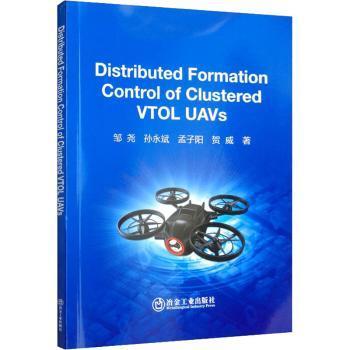
垂直起降飞行器集群分布式编队控制
- 书名
- 垂直起降飞行器集群分布式编队控制
- 作者
- 邹尧 等
- 出版社
- 冶金工业出版社
- 出版时间
- 2022-03-01
- ISBN
- 9787502490980
- 货号
- 1202637197
- 品相
- 全新
- 分类
- 当代·工业
- 书名
- 垂直起降飞行器集群分布式编队控制
- 作者
- 邹尧 等
- 出版社
- 冶金工业出版社
- 出版时间
- 2022-03-01
- ISBN
- 9787502490980
- 货号
- 1202637197
- 品相
- 全新
- 分类
- 当代·工业
目录▼
1 Introduction
1.1 Research Significance
1.2 Research Overview
1.2.1 Research Status on Cooperative Control Methods
1.2.2 Research Status on UAV Cluster Projects
1.3 Outline
References
2 Background and Preliminaries
2.1 Preliminaries
2.1.1 Notation and Definitions
2.1 . 2 Useful Lemmas
2.1.3 Filippov Solution and Non-Smooth Analysis
2.2 Graph Theory
2.3 System Models of VTOL UAVs
2.3.1 Attitude Representation
2.3.2 Kinematics and Dynamics of VTOL UAVs
2.4 Conclusions
References
3 Distributed Formation Control for Clustered VTOL UAVs Over a Switching Topology
3.1 Problem Statements
3.1.1 System Model
3.1.2 Switching Topology Graph
3.1.3 Control Objective
3.2 Distributed Control Algorithm Development Over a Switching Topology
3.2.1 Problem Transformation
3.2.2 Command Force Synthesis
3.2.3 Applied Torque Synthesis
3.2.4 Stability Analysis
3.3 Simulations
3.4 Conclusions
References
4 Distributed Formation Control for Clustered VTOL UAVs Over a Distance-Based Topology
4.1 Problem Statements
4.1.1 System Model
4.1.2 Distance-Based Network Topology
4.1.3 Control Objective
4.2 Distributed Control Algorithm With Connectivity Maintenance Mechanism
4.2.1 Problem Transformation
4.2.2 Command Force Synthesis
4.2.3 Applied Torque Synthesis
4.2.4 Stability Analysis
4.3 Simulations
4.4 Conclusions
References
5 Adaptive Distributed Formation Control for Clustered VTOL UAVs with Parametric Uncertainties
5.1 Problem Statements
5.1.1 System Model
5.1.2 Topology Graph
5.1.3 Control Objective
5.2 Adaptive Distributed Control Algorithm
5.2.1 Problem Transformation
5.2.2 Command Force Synthesis
5.2.3 Applied Torque Synthesis
5.2.4 Stability Analysis
5.3 Simulations
5.4 Conclusions
References
6 Adaptive Fault-Tolerant Distributed Formation Control for Clustered VTOL UAVs
6.1 Problem Statements
6.1.1 System Model
6.1.2 Actuator Faults
6.1.3 Topology Graph
6.1.4 Control Objective
6.2 Adaptive Fault-Tolerant Distributed Control Algorithm
6.2.1 Problem Transformation
6.2.2 Command Force Synthesis
6.2.3 Desired Torque Synthesis
6.2.4 Stability Analysis
6.3 Simulations
6.4 Conclusions
References
7 Distributed Formation Tracking Control for Clustered VTOL UAVs Over Undirected Topology
7.1 Problem Statements
7.1.1 System Model
7.1.2 Network Topology
7.1.3 Control Objective
7.2 Distributed Control Algorithm Development Over Undirected Topology
7.2.1 Command Force Synthesis
7.2.2 Command Attitude Extraction
7.2.3 Applied Torque Synthesis
7.2.4 Stability Analysis
7.3 Simulations
7.4 Conclusions
References
8 Distributed Formation Tracking Control for Clustered VTOL UAVs Over Directed Topology
8.1 Background
8.1.1 Problem Statements
8.1.2 Network Topology
8.2 Distributed Control Algorithm Development Over Directed Topology
8.2.1 Distributed Estimator Design
8.2.2 Problem Transformation
8.2.3 Command Force Synthesis
8.2.4 Applied Torque Synthesis
8.2.5 Stability Analysis
8.3 Simulations
8.4 Conclusions
References
9 Distributed Output-Feedback Formation Tracking Control for Clustered VTOL UAVs
9.1 Problem Statements
9.1.1 System Model
9.1.2 Network Topology
9.1.3 Control Objective
9.2 Distributed Output-Feedback Control Algorithm Development
9.2.1 Command Force Synthesis
9.2.2 Command Attitude Extraction
9.2.3 Applied Torque Synthesis
9.2.4 Stability Analysis
9.3 Simulation
9.4 Conclusions
References
文摘▼
There are nine chapters in this book. The first chapter gives some introduction. The second chapter gives some mathematical preliminaries for the convenience of the subsequent theoretical analysis. The third to sixth chapters focus on the formation flight objective; and the distributed control algorithms are proposed in the cases of switching topology, distance based topology, parametric uncertainties and actuator faults, respectively. The seventh to ninth chapters focus on the formation tracking objective, In the seventh and eighth chapters, two distributed control algorithms are developed over undirected and directed topologies, respectively. In the ninth chapter, an output-feedback distributed control algorithm is developed in the absence of velocity and angular velocity information.
This book is written for the readers who are working on the areas of aviation, robotics, aircraft, etc.