 正版
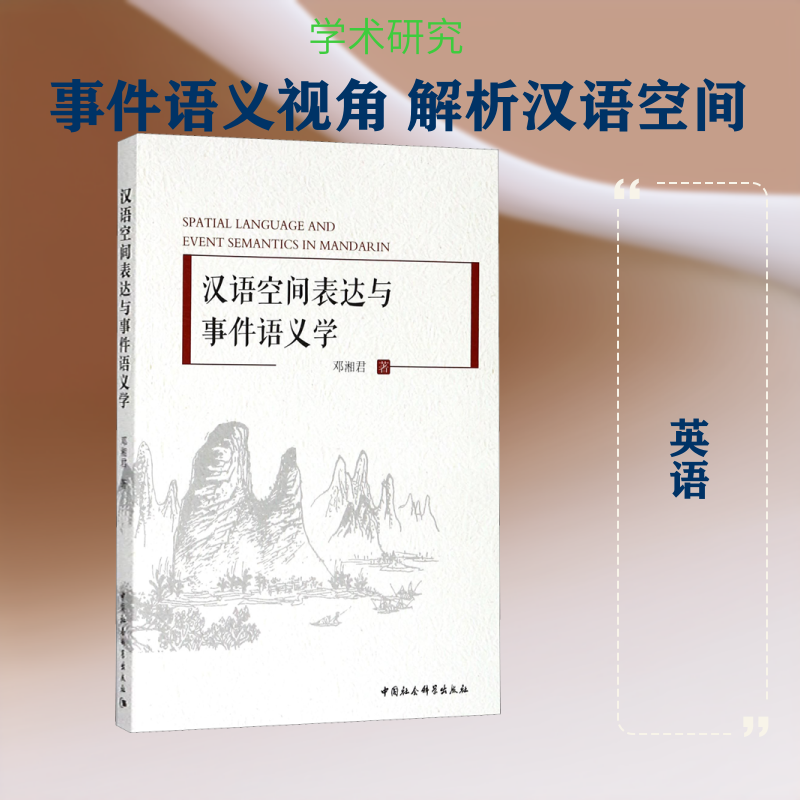
汉语空间表达与事件语义学
- 书名
- 汉语空间表达与事件语义学
- 作者
- 邓湘君 著
- 出版社
- 中国社会科学出版社
- 出版时间
- 2018-06-01
- ISBN
- 9787520326681
- 货号
- 1201835161
- 品相
- 全新
- 分类
- 当代·工业
- 书名
- 汉语空间表达与事件语义学
- 作者
- 邓湘君 著
- 出版社
- 中国社会科学出版社
- 出版时间
- 2018-06-01
- ISBN
- 9787520326681
- 货号
- 1201835161
- 品相
- 全新
- 分类
- 当代·工业
目录▼
内容简介
Preface序言
Acknowledgements
Abbreviations
Chapter 1 Space in Language
1.1 Defining space
1.1.1 Semantic primitives in motion events
1.1.2 Syntactic realizations of semantic primitives
1.2 Viewing space via event semantics: some preliminaries
1.2.1 Argument structure of a verb
1.2.2 Event type and event structure
1.3 Objectives and organization of the book
Chapter 2 Ambiguities of Mandarin Spatial Modifiers: An Event-semantic Perspective
2.1 Ambiguities in linguistic space
2.2 Explaining semantic ambiguity of spatial modifiers
2.2.1 The principle of (sub) event modification
2.2.2 The principle of aspect shift
2.3 Event semantics in framing Chinese motion events
2.4 Remedies for ambiguity in linguistic space
Chapter 3 Distribution of zai in Mandarin
3.1 Verb classification based on event type
3.2 Classification of spatial prepositions
3.3 Spatial prepositional phrases headed by zai (zai-PPs)
3.3.1 Distribution of zai-PPs
3.3.2 An event-semantic account of the use of zai-PPs
3.3.3 Syntactic positions of zai-PPs
3.3.4 Cognitive constraints on the use of zai-PPs
3.3.5 Diachronic changes of zai
3.4 Summary and discussion
3.5 Acquisition of zai
Chapter 4 Localizer Phrases, Locative Subjects, and Locative Object
4.1 Syntax and semantics of localizers and localizer phrases
4.2 Locative subjects
4.2.1 Information structure of locative subject sentences
4.2.2 Aspectual properties of locative subject sentences
4.2.3 One-argument locative subject sentences
4.2.4 Nature of locative subjects: subject or topic?
4.3 Syntax and semantics of locative objects
4.4 Summary
4.5 Acquisition of the localizer phrase and the locative subject construction
Chapter 5 Linguistic Space, Perception, and Cognition
5.1 Frames of reference, reference strategies and Figure-Ground asymmetry
5.2 Effects of cognitive development on language development
5.2.1 Frames of reference and reference strategies used by children
5.2.2 Acquisition sequence of localizers
5.2.3 Early awareness to Figure-Ground asymmetry
5.2.4 Summary
Chapter 6 Beyond the Domain of Spatial Language
6.1 The application of event semantics to the study of spatial encoding in Mandarin
6.2 A better understanding of linguistic space from the perspective of perception and cognition
6.3 Other contributions
References
文摘▼
《汉语空间表达与事件语义学》系统探讨汉语空间表达,从词、短语及句子多个层面考察汉语普通话如何对空间概念进行编码。作者引介了西方的事件语义学,将其核心概念(如事件类型、事件结构)和语义原则应用于汉语表达空间关系最重要的几种句式的分析上。我们发现这些语义原则可以统一地描写及解释“在”的空间介词短语和处所主语句的句法语义特征。
此外,《汉语空间表达与事件语义学》通过空间参照系统的选择等现象讨论了空间语言、知觉及一般认知系统之间的关系。